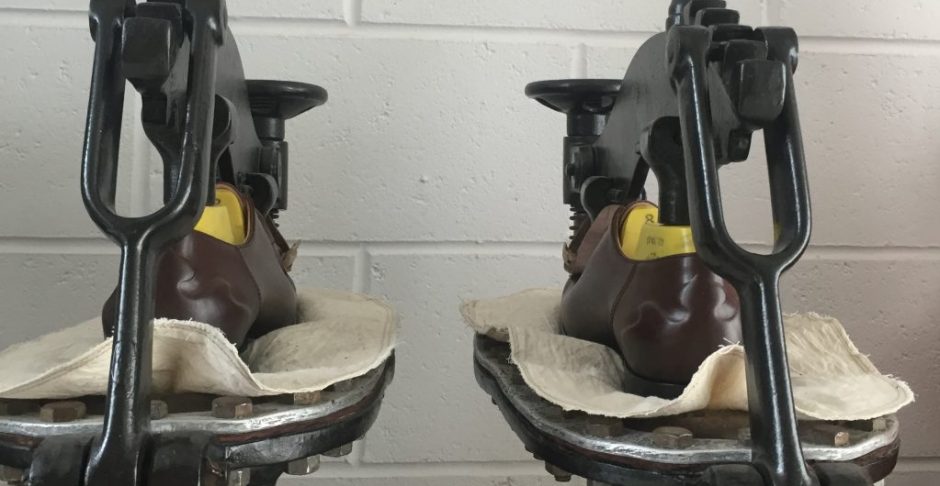

Portfolio Daphne Bikker title page
Bikker, D (2020) Portfolio Daphne Bikker [Digital], Photograph by Meewis, M. (2016)
Session/artefact to be observed/reviewed: Professional Portfolio
Size of student group: 11 students
Reviewee: Daphne Bikker
Reviewer: John O’Reilly
Part 1: Reviewee to complete
What is the context of this session/artefact within the curriculum?
This session is with the year 2 cohort of the BA (Hons) Cordwainers Footwear course. After completing year 2, students will have the option to apply for a DiPS year (Diploma in Professional Studies), a year of Industry placement. To apply for a placement, students will have to submit a CV and Portfolio. This session is to kick start and support the Portfolio development.
How long have you been working with this group and in what capacity?
I have been teaching this cohort since their Year 1 in limited capacity, and this academic year more frequently. I am unit lead of the current ‘Future Footwear’ unit.
What are the intended or expected learning outcomes?
The outcomes of this session are:
- To develop a clear understanding of what constitutes a professional Portfolio
- To begin the process of creating your own professional Portfolio
What are the anticipated outputs (anything students will make/do)?
- The creation of initial pages in draft form including a title page
Are there potential difficulties or specific areas of concern?
The most difficult part is getting started. This session is designed to help overcome that initial barrier by beginning the process together. Through examples of good practice and by highlighting sources of inspiration, the aim is to make the process easier and less overwhelming.
How will students be informed of the observation/review?
I have informed the students in person during an earlier session and followed up with an email inviting any objections. No objections were received. There was also a reminder of the observation in last Friday’s newsletter.
What would you particularly like feedback on?
Happy to hear about any ways I could improve my session.
How will feedback be exchanged?
Through email please.
Part 2: Reviewer to note down observations, suggestions and questions.
Echoing the quality of the slides and your communication, what came across most strongly through the lesson is clarity and focus in the composition and edit of a portfolio. One of the things that was tacit in your presentation that making the portfolio is also a practice, a feature of student practice. Seeing portfolio as practice, rather than simply an instrument, a tool, a personal promo (of course it is all of these) can help a student emotionally and psychologically move away from the idea of a perfect self-representation and seeing the portfolio-self as more like the practice of a work-in-progress – you mentioned early on that it was something you continually update.
You demystified and simplified the portfolio so well, it might be worth surfacing this aspect as part of an opening slide of ‘contents’ (a thought I will return to). The ‘contents page’ would simply foreground key points you are already making. Perhaps you quickly run through the portfolio first then ‘deconstruct’ it with slides that highlight key points?
You were excellent all the way through in highlighting for the students that they need to have a sense of their audience. The contents page could have an ‘audience’ section, an audience slide might combine in a couple of bullet-points the things you already say. For example in highlighting the value of the first page in a portfolio (like a magazine cover) that it says something “to people who don’t have time for going through large portfolios”.
You show a striking visual alongside name, highlighting “something about me” and contact details.
Your teaching is really strong in how it communicates the value of ‘storytelling’ – so the following slide after the opening shows “something that might connect with the client or company you are sending the portfolio to.” It might be worth highlighting the portfolio as a story?
It’s a lesson in design, branding and storytelling. You say, “I keep my layout clean, but you might want to do it differently. It also depends on the client as to how you want to design it. Cors as a client would be very different to Puma.” Comes back to this idea of audience.
The breakdown of the different elements that need communicating and how it is communicated has a compelling logic as you explain the rationale behind each layout – there is the design detail of a ‘the line’ that you use to separate out CAD sketches from other information. In your conversation with a student later you pick out a line from one of his drawings suggesting it can be used as a divider, it becomes a little brand detail.
Listing projects to show variety is another valuable insight, but that “you don’t need to put all your best stuff on here.” Coming back to the issue of rationale, you show slides which speak to different consumer categories in which the layout is different but there are consistent elements running through such as ‘the line’.
Great concluding advice around: copyright detail; labelling the file with your name; making your own project if you are applying to Ralph Lauren and have no relevant work; and most valuable “ask a flatmate to read it.”
Your conversation with the student who needed help had the quality of free enquiry, he was very open which is super-important regarding portfolio construction (he was worried about a ‘cringe image’).
It was a well organized session, really clear with insight around what clients are looking for. Coming back to the suggestion I made at the beginning I would construct the slides like a piece of editorial design, a contents page, break it up and section it with a slide with one word on it ‘audience’ or ‘personal biography’, perhaps a couple of bullets with some of your insights. You have so many nuggets of wisdom that need to be highlighted for the students, almost as a little checklist or toolkit.
Readings you may find useful
“Shoes have long been recognised as a medium to narrate stories of social and cultural histories, inspiring school projects, museum collections (see Brydon, 1998), and closets alike, and shoes have been a topic in my teaching for many years now, as visual art-making activity that is easily adapted in clay or fibre arts, sculpture and more. However, across the curriculum, feet have limited consideration beyond physical education, theatre and dance, so I invite student-teachers to consider the histories of their favorite shoes as identity markers, and how they can conceptualise visual art differently through their feet, rather than relying solely on hands or heads.”
Sinner, A. (2022) ‘Speculative steps with story shoes: Object itineraries as sensual a-r-tography’, Educational Philosophy and Theory, 54:5, 596-605, DOI: 10.1080/00131857.2021.1872019
“For example, in Dutch, learning and teaching are not separated into two words as they are in English. Rather, one word, leren, means both to learn and to teach. Leren encompasses practices of receiving, collecting, absorbing, acquiring, training, practicing, studying, teaching, educating, qualifying, mastering and familiarising. Moving across languages helps to problematise what it means to learn and what it means to teach, for the two are not so disconnected. As others have argued, education is not something that only occurs in schools. And as I explore later in the book, education is also something which is engineered and designed in non-school spaces too.”
Harris, A. (2020) A Sensory Education Routledge. https://doi.org/10.4324/9781003084341
Part 3: Reviewee to reflect on the reviewer’s comments and describe how they will act on the feedback exchanged.
Many thanks John for your positive and constructive feedback!
I designed this session as one complete example of practice. You might have heard me say at the start that “this is an opportunity for me to ‘preach what I practice’, as it is, in fact, my own portfolio that I am showcasing (I also do ensure to mention that it is indeed just one example of a portfolio and not the gold standard of portfolios!).
Your suggestion of first presenting the portfolio and then deconstructing it, is really compelling. It would create distinct moments within the session where I can pause and highlight specific elements in more depth. For example, when discussing “different audiences,” I could introduce contrasting portfolio pages tailored to particular contexts. A page designed for COS might feature a clean, minimal aesthetic with natural, muted tones, while one for NIKE could embrace bold colours and dynamic, energetic compositions.
COS Campaign
COS (2025). COS Campaign. Available at: https://www.cos.com/en-gb/women/new-arrivals. (Accessed 23 March 2026)
Nike Kids Campaign
Gorny, L. (2022). A squishy identity for Nike Kids embraces the way young people play. Available at: https://www.itsnicethat.com/news/burn-and-broad-nike-kids-never-done-playing-graphic-design-131022. (Accessed 23 March 2026)
This approach could indeed make the session more structured and also allow for clearer, more intentional comparisons, helping participants better understand how design choices need to shift depending on audience and purpose.
The two suggested readings both highlight embodied learning and how the body, objects and the environment all work together to shape an experience. Sensory education is described as something not natural, or automatic, but something that can be learned and developed over time. An idea I find particularly reassuring, because it means that everyone can have access to it. In the context of a digitally focused subject such as portfolio design, introducing tangible elements could significantly enrich this sensory experience. Bringing in physical sources of inspiration, such as purposedly designed books like the one below, could help demonstrate a more diverse range of layouts, material qualities, and visual approaches. Especially valuable in engaging such a digitally oriented generation!
Nike: Better is Temporary
Coffee table books.com. (2025). Nike: Better is Temporary. Available at: https://www.koffietafelboeken.nl/en/product/nike-better-is-temporary (Accessed 23 March 2026)
The text by Harris (2020), which explores the Dutch word ‘leren’, encompassing both ‘teaching’ and ‘learning’ in English, is a great find. In Dutch, the sentence “Hij leert” can mean either “He learns” or “He teaches.” Only through the addition of prepositions or object pronouns does the direction of leren become clear and the intended meaning fully emerge.
This single Dutch word indeed reinforces the idea that teaching and learning are not separate, but deeply interconnected processes. I recognise this in my own practice as an educator, where the boundaries between the two are often fluid. Students bring diverse experiences, perspectives, and forms of knowledge into the classroom, which continually shape and enrich the learning environment. Remaining open to this exchange allows me not only to teach, but also to learn every day.
References
Harris, A. (2020) A Sensory Education Routledge. https://doi.org/10.4324/9781003084341
Sinner, A. (2022) ‘Speculative steps with story shoes: Object itineraries as sensual a-r-tography’, Educational Philosophy and Theory, 54:5, 596-605, DOI: 10.1080/00131857.2021.1872019